Chart
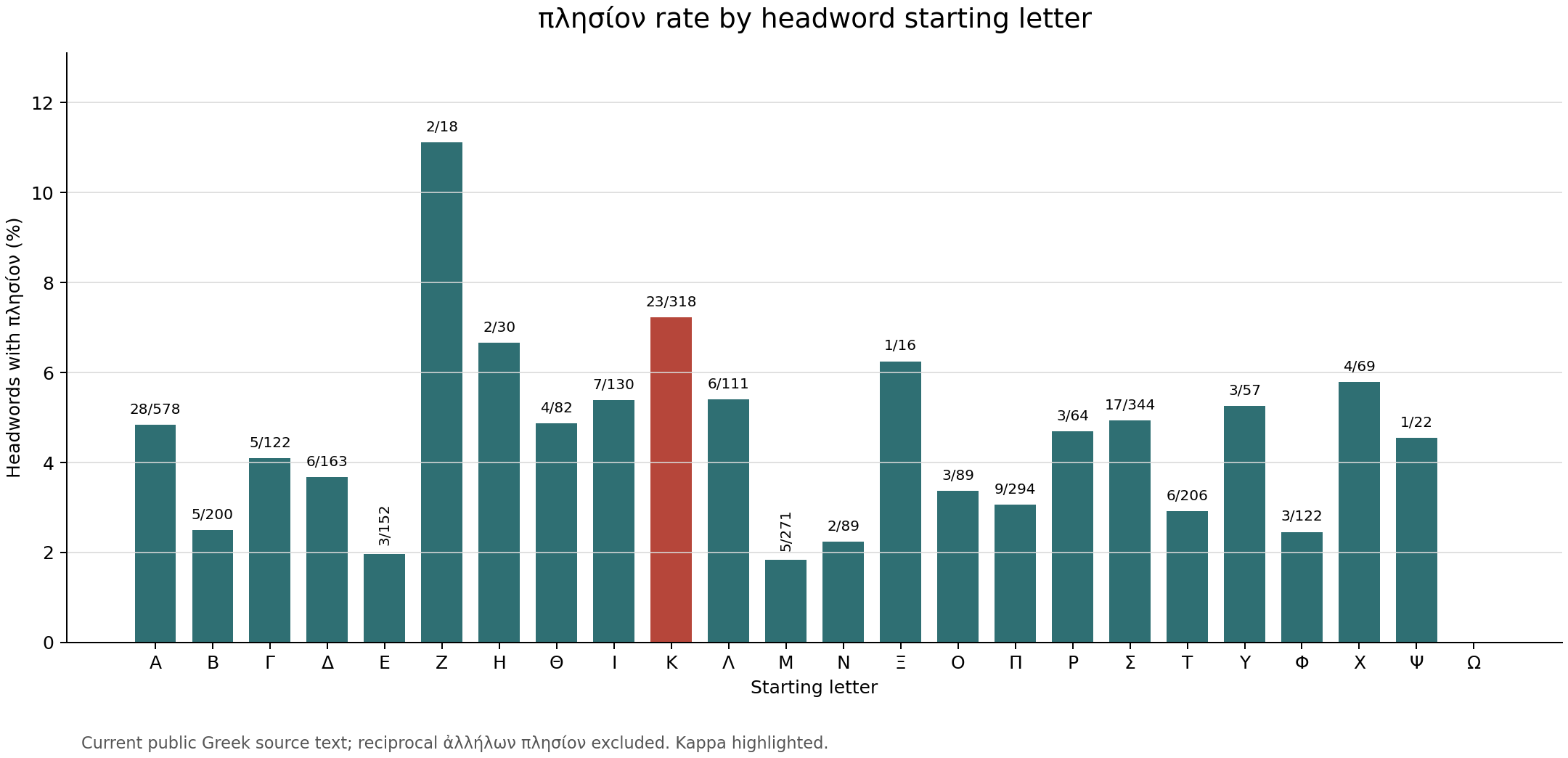
This is the dated corpus snapshot used for the chart circulated on 20 June 2026. It measures how often an entry contains πλησίον, grouped by the first letter of its headword.
| Letter | Headwords | Headwords with πλησίον | Rate |
|---|---|---|---|
| Α | 578 | 28 | 4.84% |
| Β | 200 | 5 | 2.50% |
| Γ | 122 | 5 | 4.10% |
| Δ | 163 | 6 | 3.68% |
| Ε | 152 | 3 | 1.97% |
| Ζ | 18 | 2 | 11.11% |
| Η | 30 | 2 | 6.67% |
| Θ | 82 | 4 | 4.88% |
| Ι | 130 | 7 | 5.38% |
| Κ | 318 | 23 | 7.23% |
| Λ | 111 | 6 | 5.41% |
| Μ | 271 | 5 | 1.85% |
| Ν | 89 | 2 | 2.25% |
| Ξ | 16 | 1 | 6.25% |
| Ο | 89 | 3 | 3.37% |
| Π | 294 | 9 | 3.06% |
| Ρ | 64 | 3 | 4.69% |
| Σ | 344 | 17 | 4.94% |
| Τ | 206 | 6 | 2.91% |
| Υ | 57 | 3 | 5.26% |
| Φ | 122 | 3 | 2.46% |
| Χ | 69 | 4 | 5.80% |
| Ψ | 22 | 1 | 4.55% |
| Ω | 21 | 0 | 0.00% |
Kappa has 23 πλησίον headwords among 318 entries (7.23%), compared with 125 among 3,250 entries outside Kappa (3.85%). The Kappa odds ratio is 1.95; a two-sided Fisher exact test gives p = 0.0073.
This supports a Kappa skew in this snapshot, not by itself a claim that Kappa had a different epitomiser. High rates for letters with small denominators, especially Zeta (2/18), should not be read as stable letter effects.
Unit: one headword. Source: one current public Greek text per headword at the snapshot date, using project priority Kiesling before Meineke. A headword counts when its normalized Greek text contains πλησίον. Reciprocal ἀλλήλων πλησίον is excluded. The starting letter comes from the Billerbeck identifier when present, with the Greek lemma as fallback.
Snapshot date: 2026-06-20. The site build republishes the committed PNG and CSV so the cited figures remain stable as the live corpus changes.