Kappa entry length versus translation quality
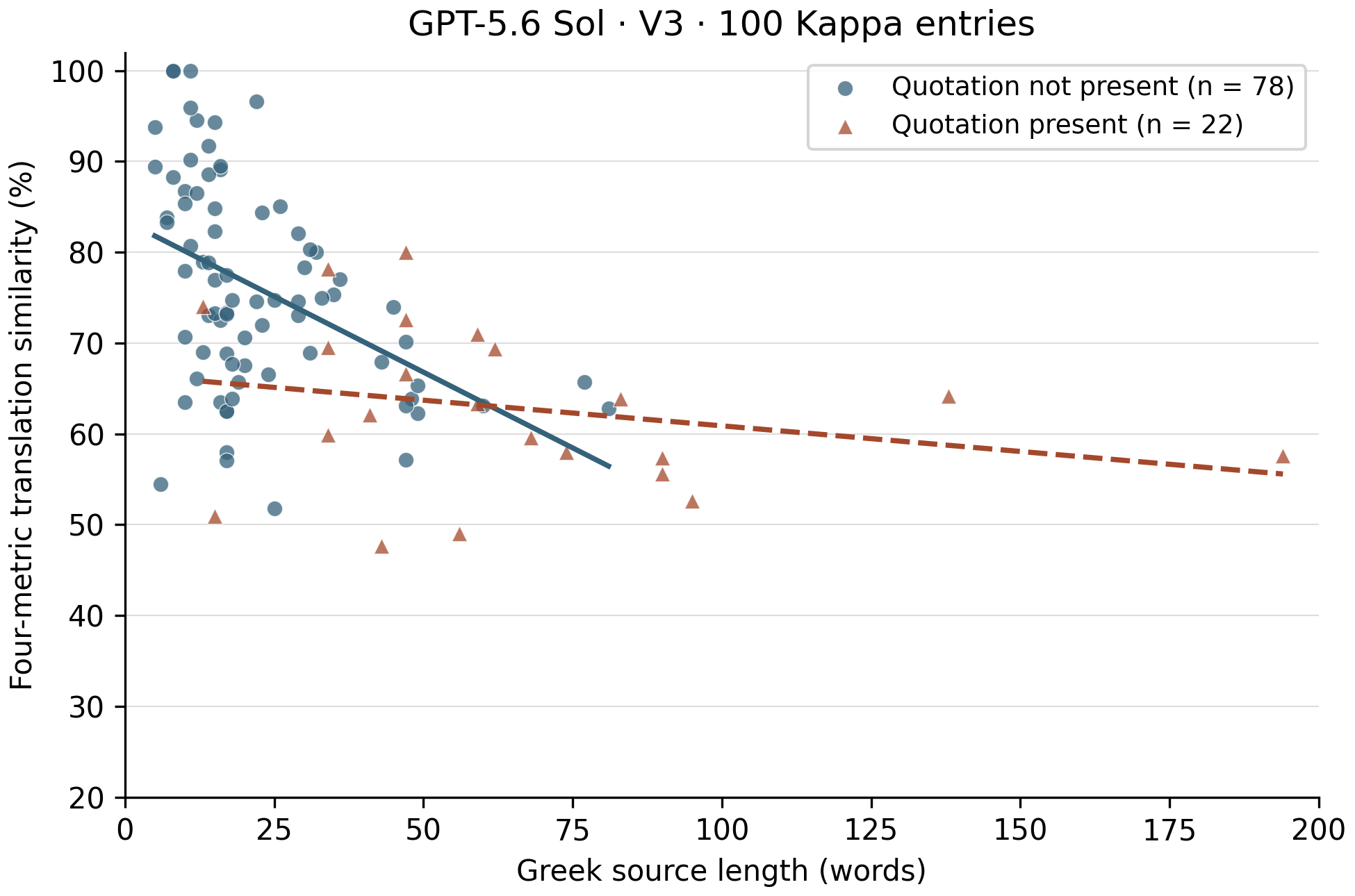
All and only the 100 headwords in Gabe's frozen final Kappa review tracker are shown. Quality is reference similarity for gpt-5.6-sol prompt v3, not an expert judgment of correctness. Select a metric, search for a headword, or click a point.
Greek length counts whitespace-delimited items containing a Greek letter, including one-letter words. Editorial brackets within a word do not split it.
Interactive chart
Do explicit quotations predict better translation scores?
No. In this cohort, entries with an explicit quotation scored lower, not higher. Their unadjusted four-metric mean was 62.9% versus 76.0% for entries without one.
The raw difference is statistically significant under a two-sided Welch comparison: -13.1 pp (95% CI -17.8 pp to -8.4 pp; p=1.53e-06; Cohen's d=-1.17). This is a descriptive group comparison, not evidence that quotation itself caused the lower score.
Quotation entries were also much longer: 64.7 versus 22.5 Greek words on average. After a linear adjustment for source length, the quotation association was -6.7 pp (95% CI -13.3 pp to -0.1 pp; HC3 p=0.047).
The incremental predictive value is weak. In leave-one-out cross-validation, adding the quotation flag to a linear length model changed R2 from 0.191 to 0.218, while mean absolute error changed from 8.73 to 8.74 score points. Alternative log-length and quadratic-length specifications give different estimates of the incremental benefit (below). This additive model assumes parallel slopes; the separate-line analysis also examines that assumption.
Score-by-score comparison
| Reference-similarity score | Quotation mean | No-quotation mean | Raw difference | Raw 95% CI | Welch p | Length-adjusted effect | Adjusted 95% CI | HC3 p |
|---|---|---|---|---|---|---|---|---|
| Four-metric mean | 62.9% | 76.0% | -13.1 pp | -17.8 pp to -8.4 pp | 1.53e-06 | -6.7 pp | -13.3 pp to -0.1 pp | 0.047 |
| BLEU-4 | 41.2% | 59.7% | -18.4 pp | -25.3 pp to -11.6 pp | 1.85e-06 | -9.9 pp | -19.4 pp to -0.3 pp | 0.044 |
| chrF++ | 66.3% | 78.1% | -11.8 pp | -16.2 pp to -7.4 pp | 2.88e-06 | -6.4 pp | -12.7 pp to -0.0 pp | 0.048 |
| METEOR | 71.5% | 83.2% | -11.7 pp | -16.8 pp to -6.6 pp | 4.87e-05 | -5.6 pp | -12.5 pp to +1.2 pp | 0.107 |
| ROUGE-L | 72.5% | 82.9% | -10.4 pp | -14.6 pp to -6.2 pp | 9.36e-06 | -4.9 pp | -10.3 pp to +0.5 pp | 0.076 |
Out-of-sample sensitivity to the length model
| Length specification | Length-only R2 | Length + quotation R2 | Change | Length-only MAE | Length + quotation MAE |
|---|---|---|---|---|---|
| Linear words | 0.191 | 0.218 | +0.027 | 8.73% | 8.74% |
| Log words | 0.302 | 0.304 | +0.002 | 7.97% | 8.00% |
| Quadratic words | 0.231 | 0.226 | -0.005 | 8.37% | 8.42% |
Operational definition. “Explicit quotation” means that the Greek source contains at least one balanced “…” span. This reproducible rule excludes guillemets used around individual letters or forms. It does not identify uncited paraphrases or parallel passages, and it is only a proxy for possible prior representation in model training data. The outcome is entry-level similarity to the approved house translation for one gpt-5.6-sol v3 run per entry, not an expert correctness score. The primary regression is ordinary least squares with a linear word-count term and HC3 heteroskedasticity-robust uncertainty; individual metric rows are exploratory and not multiple-comparison adjusted.
Length, quotations and vocabulary
Separate ordinary least-squares lines describe entries with and without explicit quotations. Each line spans only its group’s observed source lengths. Colours, point shapes and line styles distinguish the groups.
| Category | Entries | Score points per ten words | 95% HC3 interval |
|---|---|---|---|
| Quotation not present | 78 | -3.33 | -4.65 to -2.02 |
| Quotation present | 22 | -0.56 | -1.44 to 0.31 |
The quotation-minus-no-quotation slope difference was +2.77 points per ten words (95% HC3 CI 1.22 to 4.32; interaction p = 0.0006). The evidence for different slopes weakened when using log length (interaction p = 0.186) or restricting both groups to their overlapping 13–81 word range (n = 74; p = 0.393). These exploratory regressions do not establish that quotations or register changes cause difficulty.
Vocabulary associated with lower scores after allowing for length
The vocabulary-plus-length model achieved held-out R² = 0.447 and mean absolute error 7.06 score points.
The table lists the eight most negative coefficients in a ridge model combining Greek unigrams and bigrams with standardized log(1 + Greek words). Terms occur in at least two entries. The vectorizer and penalty selection were fitted inside each training fold; ten outer folds assessed prediction, and five inner folds selected the penalty by mean absolute error. Coefficients below come from a final full-cohort refit with the penalty selected by five-fold cross-validation.
| Greek word or phrase | Entries | Score points per 0.1 TF–IDF | Negative / available outer fits |
|---|---|---|---|
| χωρίον | 2 | -1.53 | 9/9 |
| δευτέρῳ | 3 | -1.30 | 10/10 |
| πόλις ὡς | 2 | -1.24 | 8/8 |
| οἰκήτωρ | 6 | -1.05 | 10/10 |
| καὶ | 66 | -0.92 | 10/10 |
| θηλυκῶς | 5 | -0.90 | 10/10 |
| καὶ θηλυκῶς | 5 | -0.90 | 10/10 |
| εἰ | 4 | -0.88 | 10/10 |
TF–IDF measures the weight of a term in an entry. These are jointly fitted, regularized associations, conditional on length and other vocabulary; they are neither independent significance tests nor effects of adding a word. The terms are accent-normalized surface forms, not lemmatized vocabulary. Fold signs describe stability across overlapping training sets, not independent replications.
Across 95 source-matched entries, a ten-percentage-point increase in the share of rare tokens was associated with +1.16 score points after adjustment for log(1 + Greek words) (95% HC3 CI -1.64 to 3.96; p = 0.412). Rare means a normalized lemma recorded fewer than 50 times in Diorisis or absent from it. This does not reproduce the strong negative rarity association reported by Zainaldin et al. for Galen; the corpora, models and outcomes differ, and reference similarity is not expert-assessed accuracy. Entries without a source-matched rarity measure were excluded from this comparison, rather than assigned a rarity of zero.
All vocabulary coefficients · Regression estimates and methods
Which source features predict translation similarity?
The best out-of-sample R2 came from Greek vocabulary + log length. It explained 44.7% of held-out score variance (nested-CV R2=0.447) with mean absolute error 7.06%. Greek vocabulary + log length had the lowest MAE at 7.06% (R2=0.447).
Source structure reached R2=0.324, slightly above log length alone at 0.296, but that block includes character count, sentence count, and words per sentence and therefore carries length-adjacent signal. The standalone rarity, citation/entity, and recogniser blocks were weaker at R2=0.061, 0.067, and 0.194.
The all-available model reached R2=0.363. Removing quotation features changed R2 to 0.354 and MAE from 7.72% to 7.62%. In paired bootstrap resampling, adding quotation did not clearly change error: ΔMAE +0.10 pp (95% CI -0.21 to +0.41).
The same result appears in the narrower check: adding quotation to log length changed R2 from 0.296 to 0.281, with ΔMAE +0.18 pp (95% CI -0.15 to +0.48). Quotation is therefore useful as a descriptive marker of difficult, long entries, but not as a stable independent predictor in this sample.
Nested cross-validated feature-block comparison
Each row predicts the same four-metric mean for unseen entries. The ridge penalty, vocabulary, document frequencies, imputation, and scaling are all learned inside the training folds. The highlighted row has the highest held-out R2; feature counts are training-fold medians.
| Source feature set | Features | CV R2 | CV MAE | CV RMSE | MAE gain vs mean | Spearman r | Median ridge α |
|---|---|---|---|---|---|---|---|
| Training-fold mean | 0 | -0.028 | 10.14% | 12.48% | +0.00 pp | -0.326 | — |
| Quotation only | 3 | 0.144 | 9.42% | 11.38% | +0.73 pp | 0.134 | 30 |
| Log source length | 1 | 0.296 | 8.03% | 10.33% | +2.11 pp | 0.562 | 0.01 |
| Log source length + quotation | 4 | 0.281 | 8.21% | 10.43% | +1.93 pp | 0.557 | 3 |
| Source structure | 7 | 0.324 | 7.85% | 10.12% | +2.29 pp | 0.578 | 30 |
| Lexical rarity | 3 | 0.061 | 9.38% | 11.92% | +0.76 pp | 0.358 | 1 |
| Citations + named entities | 9 | 0.067 | 9.58% | 11.88% | +0.56 pp | 0.283 | 20 |
| Guidance recogniser hits | 78 | 0.194 | 8.56% | 11.05% | +1.58 pp | 0.467 | 100 |
| Greek vocabulary | 313 | 0.437 | 7.30% | 9.23% | +2.84 pp | 0.692 | 0.3 |
| Greek vocabulary + log length | 314 | 0.447 | 7.06% | 9.15% | +3.08 pp | 0.691 | 0.3 |
| All available source features, without quotation | 411 | 0.354 | 7.62% | 9.89% | +2.52 pp | 0.632 | 100 |
| All available source features | 414 | 0.363 | 7.72% | 9.82% | +2.42 pp | 0.635 | 100 |
What went into the all-available model?
Only information present in the Greek source before translation: log word count; explicit-quotation count and quoted-word proportion; sentence and punctuation structure; Diorisis lexical-rarity ratios; structured citation and named-entity counts; guidance-recogniser rule hits; and Greek TF-IDF unigrams and bigrams. AI-output length and any translation-similarity metric are excluded from the predictors.
Coverage. Feature source: live PostgreSQL feature tables. Recogniser hits cover 100 / 100 entries; entity features 100 / 100; citations 95 / 100; current-version rarity and sentence segmentation 97 / 100 and 99 / 100. Source-version mismatches are treated as missing and imputed within training folds. Parsed dependency-grammar coverage is 0 / 100, so it is not included. These are predictive associations in a 100-entry observational cohort; individual ridge coefficients are not treated as stable explanations.
Ten-entry review set
The 100 entries are sorted by Greek source length into ten equal groups. The lowest four-metric score in each group is selected. This gives one challenge entry from every length decile and avoids reducing review to only the ten longest or ten lowest-scoring entries.
| Length decile | Headword | Greek words | Mean quality | Review text |
|---|---|---|---|---|
| 1 | Καικῖνον | 6 | 54.5% |
Open source and translationsGreek: Καικῖνον, χωρίον Ἰταλικόν. Φίλιστος δευτέρῳ Σικελικῶν. gpt-5.6-sol v3: Kaikinon: a locality in Italy. Philistos, book 2 in his *Sikelika*. Human-approved: Kaikinon: an Italian locality. Philistos in book 2 of his *Sikelika*. |
| 2 | Καλάσιρις | 10 | 63.5% |
Open source and translationsGreek: Καλάσιρις, μοῖρα Αἰγύπτου. Ἡρόδοτος δευτέρῳ. οἱ καὶ Καλασίριοι καὶ Καλασιρίαι. gpt-5.6-sol v3: Kalasiris: a region of Egypt. Herodotus, book 2. Its inhabitants are called both 'Kalasirioi' and 'Kalasiriai'. Human-approved: Kalasiris: a part of Egypt. Herodotos, book 2. They are 'Kalasirioi' and 'Kalasiriai'. |
| 3 | Καλαβρία | 13 | 69.0% |
Open source and translationsGreek: Καλαβρία, χώρα πλησίον τῆς Ἰταλίας. ὁ οἰκήτωρ Καλαβρός, καὶ Καλαβρά θηλυκὸν καὶ Καλαβρίς. gpt-5.6-sol v3: Kalabria: a region near Italy. The inhabitant is 'Kalabros'; the feminine is 'Kalabra', and also 'Kalabris'. Human-approved: Kalabria: a region near Italy. An inhabitant is a 'Kalabros'; the feminine is 'Kalabra' as well as 'Kalabris'. |
| 4 | Κασώριον | 15 | 51.0% |
Open source and translationsGreek: Κασώριον, τὸ πορνεῖον. Ἀριστοφάνης “ἐν κασωρίοισι λείχων”. ὁ οἰκήτωρ κασωρίτης, καὶ θηλυκῶς κασωρῖτις καὶ κασωρίς. gpt-5.6-sol v3: Kasorion: a brothel. Aristophanes: ‘licking in brothels’. Its patron is called a ‘kasorites’, and the feminine forms are ‘kasoritis’ and ‘kasoris’. Human-approved: Kasorion: a brothel. Aristophanes: 'licking in the kasorion...'. An inhabitant is a 'kasorites'; and in the feminine 'kasoritis' or 'kasoris'. |
| 5 | Κριώα | 17 | 57.1% |
Open source and translationsGreek: Κριώα, δῆμος τῆς Ἀντιοχίδος φυλῆς. ὁ δημότης Κριωεύς. τὰ τοπικὰ Κριῶθεν κατὰ συγκοπὴν καὶ Κριῶζε καὶ Κριῶσιν. gpt-5.6-sol v3: Krioa: a deme in the tribe Antiochis. The deme-member is called 'Krioeus'. The locative terms are 'Kriothen' by syncope, 'Krioze', and 'Kriosin'. Human-approved: Krioa: a deme of the Antiochis tribe. A deme-member is a 'Krioeus'. The locative terms are 'Kriothen' (through syncope) as well as 'Krioze' and 'Kriosi'. |
| 6 | Κάληρος | 25 | 51.8% |
Open source and translationsGreek: Κάληρος, οὕτως ἐκαλεῖτο ἡ Ἀλωπεκόννησος ἀπὸ Καλήρου βασιλέως, Ἀλωπεκόννησος δὲ ὅτι ἐκεῖ εἶδον σκύμνους φέρουσαν καὶ κατατιθεῖσαν ἀλώπεκα. τινὲς δ´ ὅτι δεκάληρος ἐκαλεῖτο ἡ πόλις. gpt-5.6-sol v3: Kaleros: Alopekonnesos used to be called this after King Kaleros; it was called Alopekonnesos because there they saw a fox carrying and setting down cubs. Some, however, say that the city was called 'Dekaleros'. Human-approved: Kaleros: this used to be what Alopekonesos was called, after the king Kaleros; it is now 'Alopekonesos' because they saw a fox carry her cubs there and put them down. Some say that the city used to be called 'Dekalaros'. |
| 7 | Κύρνος | 34 | 59.9% |
Open source and translationsGreek: Κύρνος, νῆσος πρόσβορρος Ἰαπυγίας. Ἑκαταῖος Εὐρώπῃ. τὸ ἐθνικὸν Κύρνιοι καὶ Κυρναῖοι. φασὶ δὲ “τοὺς Κυρναίους πολυχρονιωτάτους εἶναι (οἰκοῦσι δὲ οὗτοι περὶ τὴν Σαρδόνα) διὰ τὸ μέλιτι ἀεὶ χρῆσθαι. πλεῖστον δὲ τοῦτο γίνεται παρ´ αὐτοῖς”. gpt-5.6-sol v3: Kyrnos: an island to the north of Iapygia. Hekataios in his *Europe*. The ethnonyms are 'Kyrnioi' and 'Kyrnaioi'. They say that ‘the Kyrnaioi are exceedingly long-lived (they dwell around Sardona) because they continually use honey; and this is produced in very great abundance among them’. Human-approved: Kyrnos: an island to the north of Iapygia. Hekataios in his *Europe*. The ethnonym is 'Kyrnioi' or 'Kyrnaioi'. They say 'that the Kyrnaioi are extremely long-lived (those who live round about Sardinia) because they constantly make use of honey, and this is produced by them in the greatest quantities.' |
| 8 | Κάναστρον | 43 | 47.7% |
Open source and translationsGreek: Κάναστρον, ἄκρον Θρᾴκης καὶ Μακεδονίας. τὸ ἐθνικὸν Καναστραῖος. Σοφοκλῆς δὲ ὑπομνηματίζων τὰ ἀργοναυτικά “Καναστραῖον” φησίν “ἀκρωτήριον τῆς Παλλήνης”. ἀλλ´ ἐναντιοῦται τὰ ἐθνικά, εἰ μὴ καὶ τοῦτο ἐκλάβοιμεν παραπλησίως τῷ Λέχαιον καὶ Λεχαῖος, καὶ Λύκειον τὸ γυμνάσιον καὶ Λυκεῖος Ἀπόλλων, καὶ Νύμφαιον καὶ Νυμφαῖος. gpt-5.6-sol v3: Kanastron: a cape in Thrace and Makedonia. The ethnonym is 'Kanastraios'. Sophokles, commenting on the Argonautic material, says: ‘Kanastraion, a promontory of Pallene.’ But the ethnonyms are at variance, unless we understand this too in a manner similar to 'Lechaion' and 'Lechaios', 'Lykeion' the gymnasium and Apollo Lykeios, and 'Nymphaion' and 'Nymphaios'. Human-approved: Kanastron: a cape of Thrace and Macedonia. The ethnonym is 'Kanastraios', but Sophokles has 'Kanastraion' in his commentary on *The Argonautika*, saying it is 'a cape of Pallene'. However, the ethnonyms run contrary to this, unless we were to understand this as having the same pattern as 'Lechaion' and 'Lechaios', 'Lykeion' (the gymnasium) and Apollo 'Lykeios', or 'Nymphaion' and 'Nymphaios'. |
| 9 | Κώμη | 56 | 49.1% |
Open source and translationsGreek: Κώμη, ἐν ταῖς μακραῖς ὁδοῖς μέσα χωρία ἔκτισαν πρὸς τὸ κοιμᾶσθαι νυκτὸς ἐπιγενομένης, ὅθεν καὶ ἐπικέκληται, ὡς Φιλόξενος. ὁ οἰκήτωρ ἐγκώμιος. Ἡσίοδος “εἰ γάρ τοι καὶ χρῆμ´ ἐγκώμιον ἄλλο γένοιτο”. καὶ κωμαῖος καὶ κωμήτης ἀρσενικῶς καὶ θηλυκῶς διὰ τοῦ « ι ». καὶ ὁ δῆμος κώμη. εἴρηται ἀπὸ τοῦ ἐν αὐταῖς κοιμᾶσθαί τε καὶ αὐλίζεσθαι. λέγεται καὶ κωμήτωρ. gpt-5.6-sol v3: Kome: on long roads they built halfway points for sleeping when night came, from which it also received its name, as per Philoxenos. The inhabitant is an 'enkomios'. Hesiod: ‘For even if some other need should arise for you in the village.’ Also 'komaios', and 'kometes' in the masculine and 'kometis' in the feminine, with ι. A deme too is a 'kome'. The term is said to derive from sleeping and lodging in them. The inhabitant is also called a 'kometor'. Human-approved: Kome: along long routes they established halfway points for the purpose of sleeping when night fell, after which they are now named, as per Philoxenos. An inhabitant is an 'enkomios'. Hesiod: 'For if some matter were to arise for you as an enkomios'. And also a 'komaios', and 'kometes' in the masculine, which in the feminine is written with ι. A deme is also a kome, named after the practice of taking shelter and sleeping there. 'Kometor' is also said. |
| 10 | Καπετώλιον | 95 | 52.6% |
Open source and translationsGreek: Καπετώλιον, ἐν Ῥώμῃ λόφος Ταρπαῖος πάλαι λεγόμενος. περὶ δὲ τῆς γραφῆς τοῦ τεμενικοῦ ὁ Εὐδαίμων διὰ τοῦ « ι » φησίν “Εἰρηναῖος προπαροξύνει διὰ τοῦ « ι » γράφων”. Ἡρωδιανὸς δὲ Καπετωλίειον ἐν ἓξ συλλαβαῖς, καὶ ἐν συναιρέσει Καπετώλειον. τὸ δὲ Καπετωλεῖα ἐπὶ τοῦ ἀγῶνος προπερισπᾶται. ὅσα γὰρ ἔχει προϋπάρχοντα εἰς « ος » καθαρόν, παραληγόμενα ἢ μόνῳ τῷ « ι » ἢ προηγουμένου αὐτοῦ τοῦ « α » ὥστε εἶναι πρὸ τέλους τὴν « αι » δίφθογγον, προπερισπᾶται, ἢ καὶ ὅσα κτητικά. Ἀσκληπιεῖον, Ἀσκληπιός γάρ· Πτολεμαεῖον, Πτολεμαῖος γάρ· Ὀλυμπιεῖα τὰ Ἀθήνησιν, Ὀλύμπιος γάρ. τὸ δὲ τέμενος Καπετώλιον καὶ Καπετώλιος Ζεὺς διὰ τοῦ « ι ». τὸ ἐθνικὸν Καπετωλῖνος. gpt-5.6-sol v3: Kapetolion: a hill in Rome formerly called Tarpeios. On the spelling of the sanctuary name, Eudaimon says that it is written with ι: ‘Eirenaios accents it with an acute on the antepenult, writing it with ι.’ Herodianos gives Καπετωλίειον in six syllables, and, with vowel contraction, Καπετώλειον. Καπετωλεῖα, when it refers to the contest, is accented with a circumflex on the penult. For all forms that have an underlying form ending in pure -os and have in the penult either ι alone or ι preceded by α, so that the diphthong αι stands before the final syllable, are accented with a circumflex on the penult, as are possessive forms: ‘Asklepieion’, since the underlying form is ‘Asklepios’; ‘Ptolemaeion’, since it is ‘Ptolemaios’; the ‘Olympieia’ at Athens, since it is ‘Olympios’. The sanctuary is ‘Kapetolion’, and Zeus Kapetolios is written with ι. The ethnonym is ‘Kapetolinos’. Human-approved: Kapetolion: in Rome, a hill that was long ago called 'Tarpaios'. Regarding the spelling of the sanctuary name, Eudaimon says that it is with ι: 'Eirenaios accents it with acute on the antepenult and writes it with ι.' Herodian has 'Kapetolieion' with six syllables, and 'Kapetolion' with contraction. The form 'Kapetoleia', referring to the games, is accented with circumflex on the penult. This is because forms whose base already ends in postvocalic -ος—when either a single ι is in the penultimate position or α precedes it so that the diphthong αι stands before the ultima—will be accented with a circumflex on the penult, and the same applies to possessive forms. Asklepieion (Ἀσκληπιεῖον) is thus from 'Asklepios' (Ἀσκληπιός); Ptolemaeion (Πτολεμαεῖον) is thus from 'Ptolemaios' (Πτολεμαῖος); Olympieia (Ὀλυμπιεῖα), the one at Athens, is thus from 'Olympios' (Ὀλύμπιος). The sanctuary, however, is 'Kapetolion' (Καπετώλιον), and 'Zeus Kapetolios' (Καπετώλιος), with ι. The ethnonym is 'Kapetolinos'. |
Downloads
Verify all 100 official headwords
| Official order | Kappa entry | Headword | Greek words | Mean quality | Review set |
|---|---|---|---|---|---|
| 1 | 1 | Καβαλίς | 47 | 80.0% | |
| 2 | 2 | Καβασσός | 74 | 58.0% | |
| 3 | 3 | Καβειρία | 81 | 62.8% | |
| 4 | 4 | Καβελλιών | 23 | 72.0% | |
| 5 | 5 | Καβύλη | 16 | 89.1% | |
| 6 | 6 | Καδμεία πόλις | 17 | 62.5% | |
| 7 | 7 | Κάδοι | 13 | 74.0% | |
| 8 | 8 | Καδούσιοι | 11 | 100.0% | |
| 9 | 9 | Κάδρεμα | 14 | 73.1% | |
| 10 | 10 | Κάθαια | 17 | 58.0% | |
| 11 | 11 | Καικῖνον | 6 | 54.5% | Decile 1 |
| 12 | 12 | Καινίνη | 10 | 78.0% | |
| 13 | 13 | Καινοί | 7 | 83.8% | |
| 14 | 15 | Καινύς | 16 | 72.5% | |
| 15 | 14 | Καιρή | 11 | 80.7% | |
| 16 | 16 | Καισάρεια | 30 | 78.3% | |
| 17 | 17 | Καλαβρία | 13 | 69.0% | Decile 3 |
| 18 | 18 | Καλάθη | 32 | 80.0% | |
| 19 | 19 | Καλάμαι | 5 | 93.7% | |
| 20 | 20 | Καλαμένθη | 16 | 63.5% | |
| 21 | 21 | Κάλαρνα | 10 | 86.8% | |
| 22 | 22 | Καλάσιρις | 10 | 63.5% | Decile 2 |
| 23 | 23 | Καλατίαι | 5 | 89.4% | |
| 24 | 24 | Καλαύρεια | 20 | 70.6% | |
| 25 | 25 | Κάλβιος | 15 | 73.3% | |
| 26 | 26 | Καλὴ ἀκτή | 49 | 62.2% | |
| 27 | 27 | Κάληρος | 25 | 51.8% | Decile 6 |
| 28 | 28 | Καλησία | 12 | 94.5% | |
| 29 | 29 | Καλλάτηβος | 8 | 100.0% | |
| 30 | 30 | Κάλλατις | 47 | 57.2% | |
| 31 | 31 | Καλλίαι | 17 | 73.4% | |
| 32 | 32 | Καλλίαρος | 31 | 80.3% | |
| 33 | 33 | Καλλιόπη | 11 | 90.2% | |
| 34 | 34 | Καλλίπολις | 31 | 69.0% | |
| 35 | 35 | Κάλπη | 36 | 77.0% | |
| 36 | 36 | Καλύβη | 14 | 88.6% | |
| 37 | 37 | Κάλυδνα | 29 | 82.1% | |
| 38 | 38 | Καλυδών | 15 | 82.3% | |
| 39 | 39 | Κάλυμνα | 26 | 85.0% | |
| 40 | 40 | Κάλυνδα | 10 | 85.4% | |
| 41 | 41 | Κάλυτις | 17 | 62.5% | |
| 42 | 48 | Κάμιρος | 47 | 66.6% | |
| 43 | 51 | Κάναθα | 17 | 68.9% | |
| 44 | 52 | Κάναι | 60 | 63.1% | |
| 45 | 53 | Κάναστρον | 43 | 47.7% | Decile 8 |
| 46 | 63 | Κάνωπος | 62 | 69.4% | |
| 47 | 66 | Καπετώλιον | 95 | 52.6% | Decile 10 |
| 48 | 68 | Καππαδοκία | 59 | 63.3% | |
| 49 | 75 | Καρδαμύλη | 34 | 78.2% | |
| 50 | 82 | Καρία | 194 | 57.6% | |
| 51 | 97 | Καρπασία | 83 | 63.9% | |
| 52 | 99 | Καρπήσιοι | 7 | 83.3% | |
| 53 | 102 | Καρύανδα | 25 | 74.7% | |
| 54 | 103 | Κάρυστος | 138 | 64.1% | |
| 55 | 104 | Καρχηδών | 90 | 55.6% | |
| 56 | 105 | Κάσιον | 45 | 74.0% | |
| 57 | 107 | Κάσος | 47 | 72.6% | |
| 58 | 109 | Κοσσαῖος γενεὴν Κασπειρόθεν | 90 | 57.4% | |
| 59 | 120 | Κάσταξ | 15 | 77.0% | |
| 60 | 121 | Κάστνιον | 20 | 67.5% | |
| 61 | 122 | Καστωλοῦ πεδίον | 29 | 74.6% | |
| 62 | 123 | Κασώριον | 15 | 51.0% | Decile 4 |
| 63 | 124 | Κατάβαθμος | 16 | 89.5% | |
| 64 | 125 | Κατακεκαυμένη | 34 | 69.5% | |
| 65 | 127 | Κατάνειρα | 12 | 66.1% | |
| 66 | 126 | Κατάνη | 68 | 59.6% | |
| 67 | 129 | Καταννοί | 8 | 88.3% | |
| 68 | 128 | Καταονία | 17 | 73.2% | |
| 69 | 130 | Κάτρη | 18 | 74.7% | |
| 70 | 151 | Κεκρυφάλεια | 17 | 77.5% | |
| 71 | 180 | Κορώνεια | 77 | 65.7% | |
| 72 | 188 | Κοτιάειον | 48 | 63.8% | |
| 73 | 205 | Κρανίδες | 11 | 96.0% | |
| 74 | 222 | Κριώα | 17 | 57.1% | Decile 5 |
| 75 | 286 | Κύρβη | 8 | 100.0% | |
| 76 | 287 | Κύρη | 15 | 84.8% | |
| 77 | 288 | Κυρήνη | 35 | 75.3% | |
| 78 | 289 | Κύρης | 10 | 70.7% | |
| 79 | 290 | Κύρις | 13 | 79.0% | |
| 80 | 291 | Κύρνος | 34 | 59.9% | Decile 7 |
| 81 | 292 | Κύρου πόλις | 24 | 66.5% | |
| 82 | 293 | Κύρρος | 33 | 75.0% | |
| 83 | 294 | Κυρταία | 29 | 73.0% | |
| 84 | 295 | Κύρτος | 49 | 65.3% | |
| 85 | 296 | Κύρτωνες | 19 | 65.7% | |
| 86 | 297 | Κυρτώνιος | 14 | 78.9% | |
| 87 | 298 | Κύτα | 59 | 71.0% | |
| 88 | 299 | Κυτέριον | 18 | 63.8% | |
| 89 | 300 | Κύτινα | 22 | 96.6% | |
| 90 | 301 | Κυτώνιον | 14 | 91.7% | |
| 91 | 302 | Κύτωρος | 22 | 74.6% | |
| 92 | 303 | Κύφος | 41 | 62.1% | |
| 93 | 304 | Κυχρεῖος πάγος | 47 | 70.2% | |
| 94 | 305 | Κύψελα | 23 | 84.4% | |
| 95 | 306 | Κῶβρυς | 12 | 86.5% | |
| 96 | 307 | Κώθων | 15 | 94.3% | |
| 97 | 308 | Κωλιάς | 43 | 67.9% | |
| 98 | 309 | Κῶλοι | 18 | 67.7% | |
| 99 | 310 | Κώμη | 56 | 49.1% | Decile 9 |
| 100 | 311 | Κωνώπη | 47 | 63.1% |
Generated 2026-09-20 11:24:59 UTC. The four-metric mean is the unweighted entry-level mean of BLEU-4, chrF++, METEOR, and ROUGE-L against the approved house-style translation.