Generated: 2026-09-20 11:23:02 UTC
Profile version id: 2587
First translation using this version: 2026-07-18
Total usable AI runs for this version: 300 runs across 100 lemmas
Created: 2026-07-18 21:14:55.545407+10:00
Active: True
Notes: Arm B: Stephanos v3 static prompt shell with no matched entry-specific guidance. Model gpt-5.6-sol; Responses API; medium reasoning; top_p 1.0; three runs per Kappa-corpus entry.
| Formula | AI words = intercept + slope * human words |
|---|---|
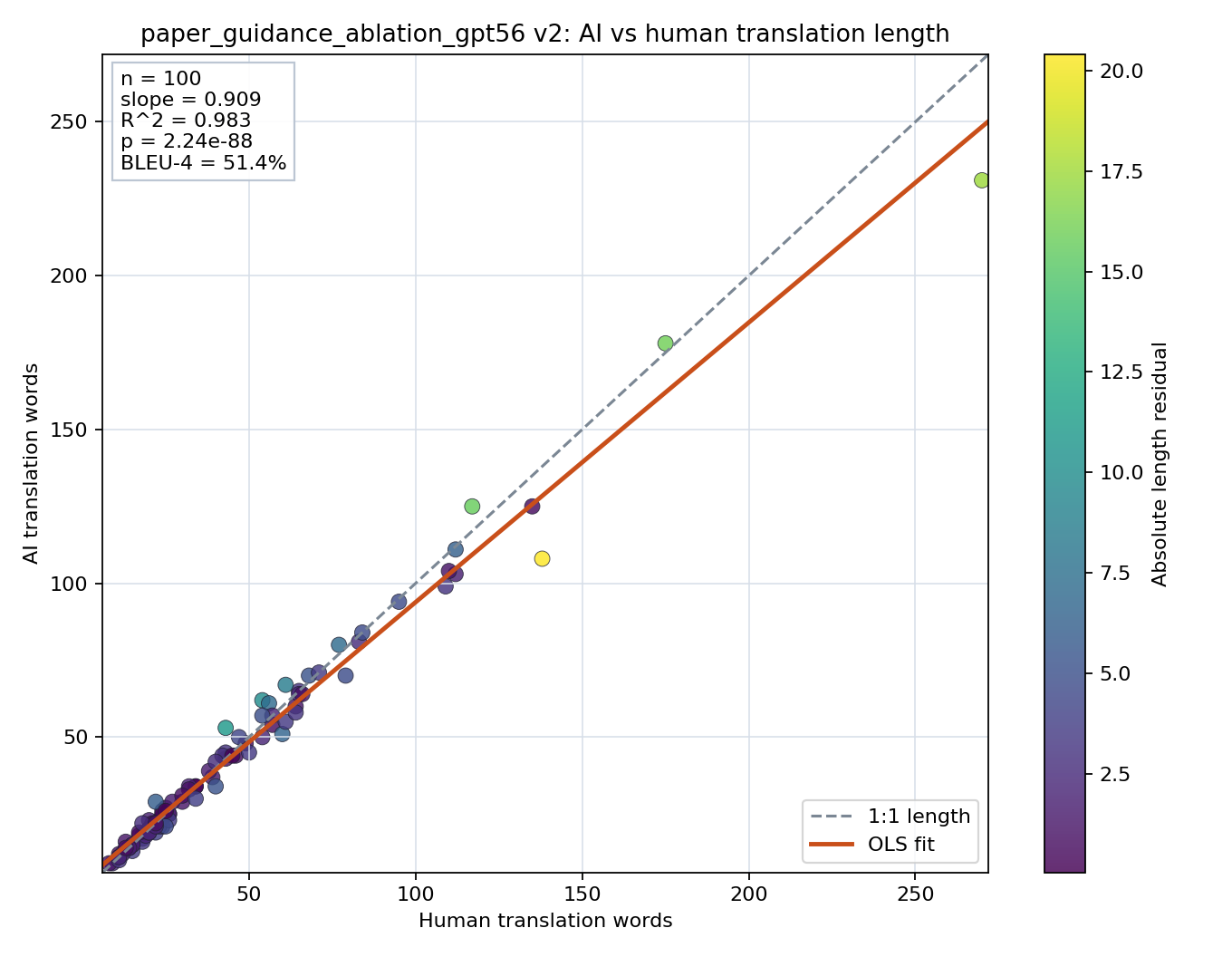
| Slope | 0.909 |
| Intercept | 2.972 |
| R^2 | 0.983 |
| P-value | 2.03e-88 |
| Pearson r | 0.991 |
| Mean source words | 30.400 |
| Length fallback rows | 0 |
| Mean human words | 44.150 |
| Mean AI words | 43.100 |
| Mean absolute length residual | 3.065 |
| Mean absolute percent error | 6.1% |
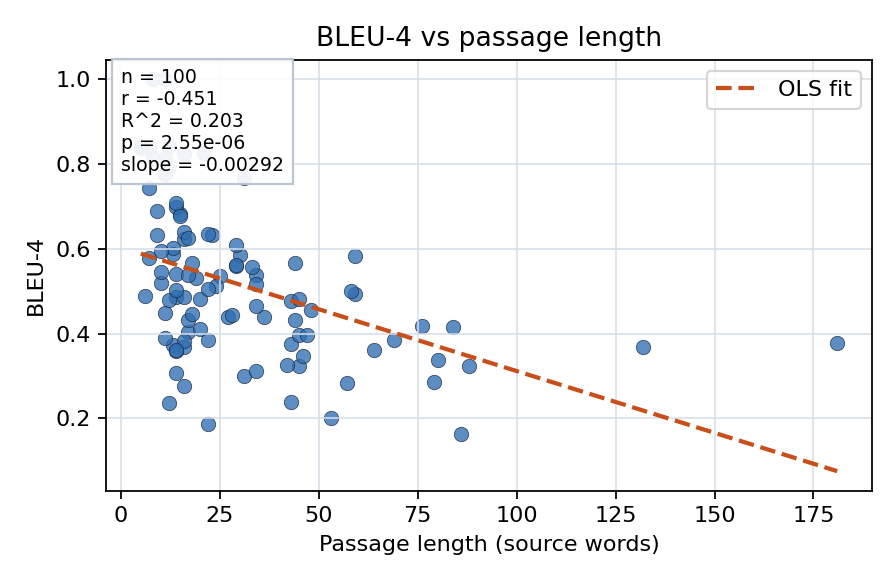
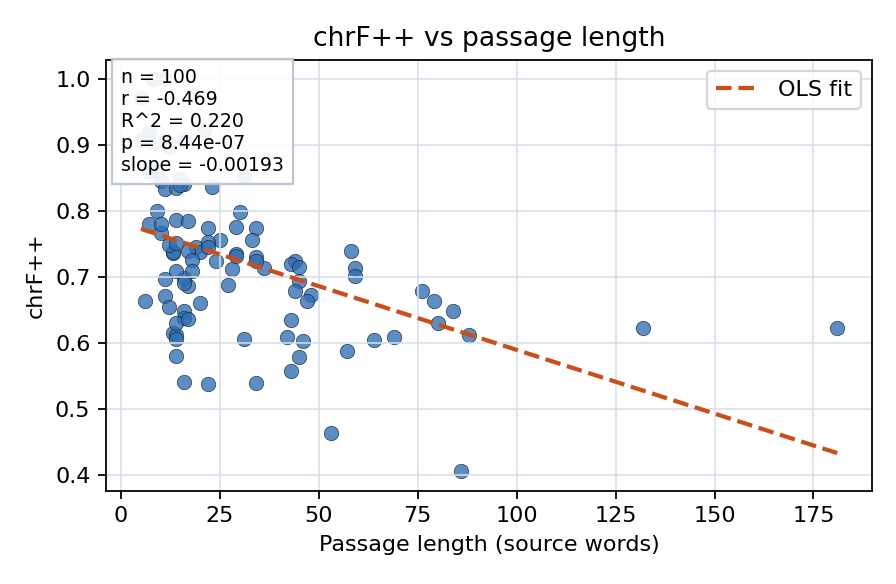
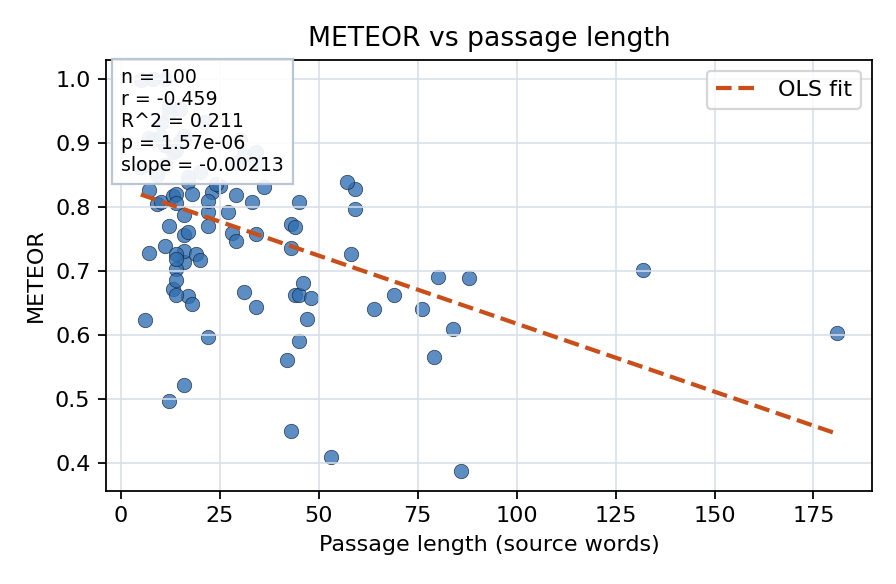
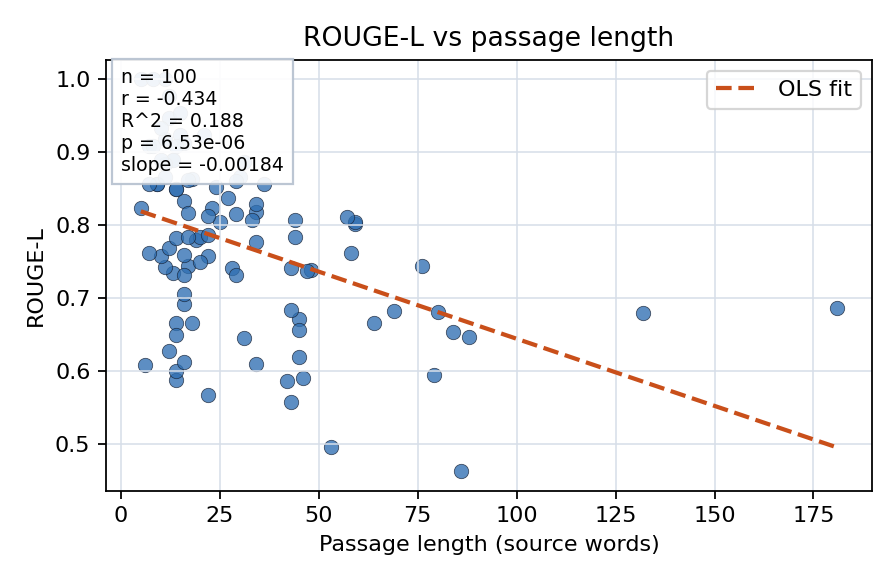
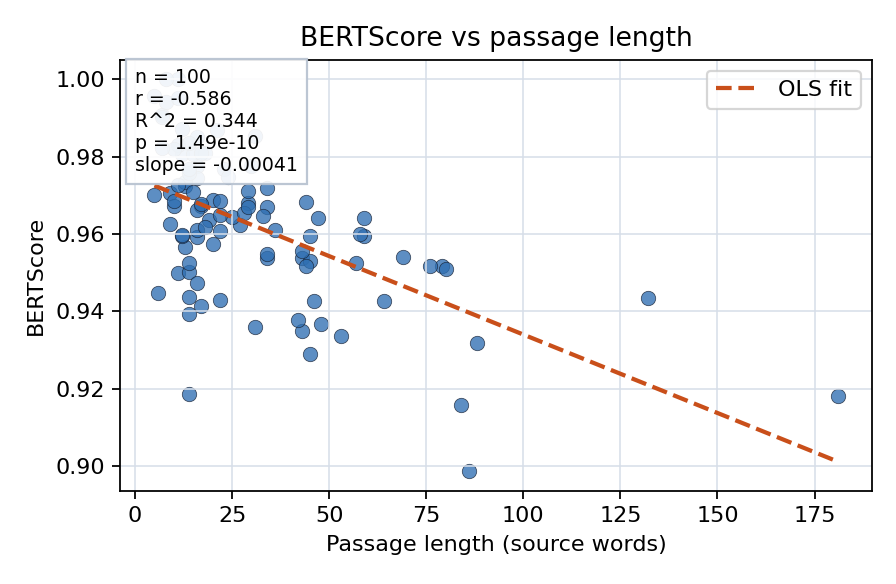
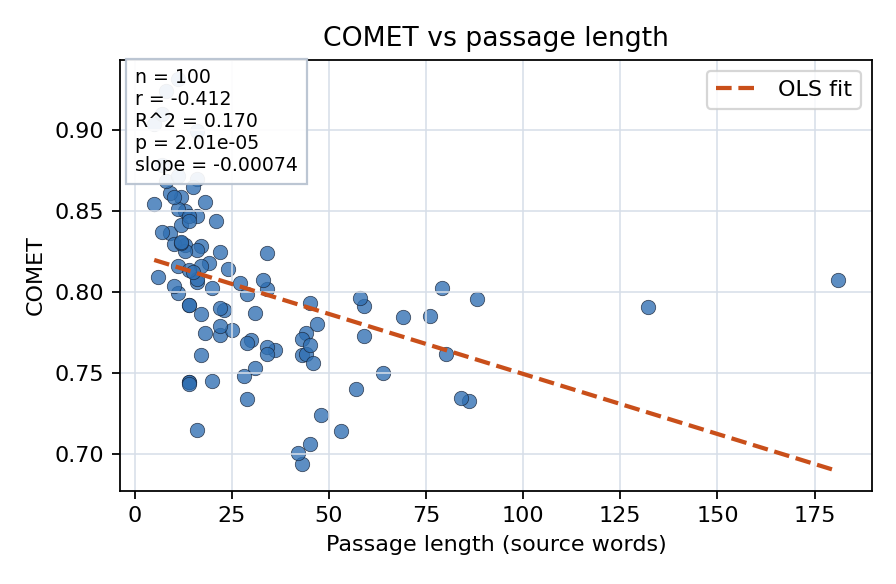
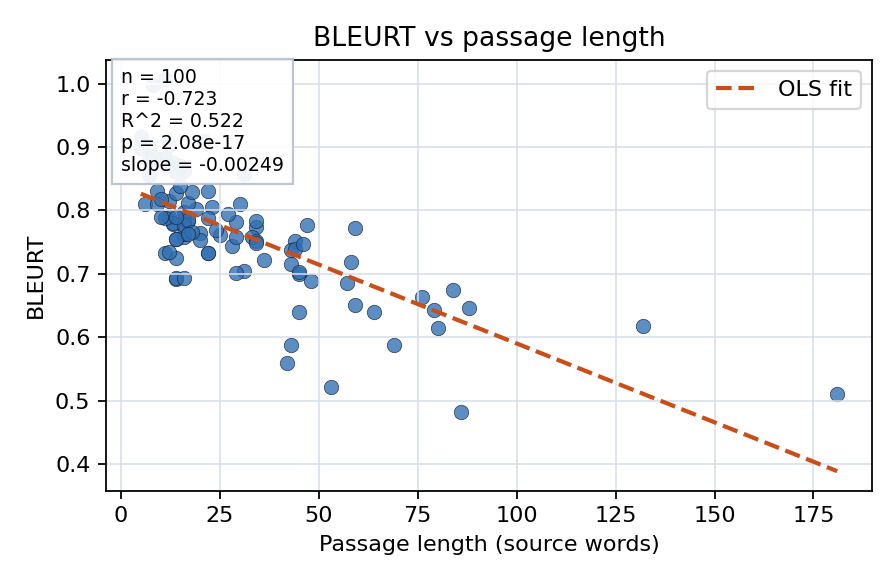
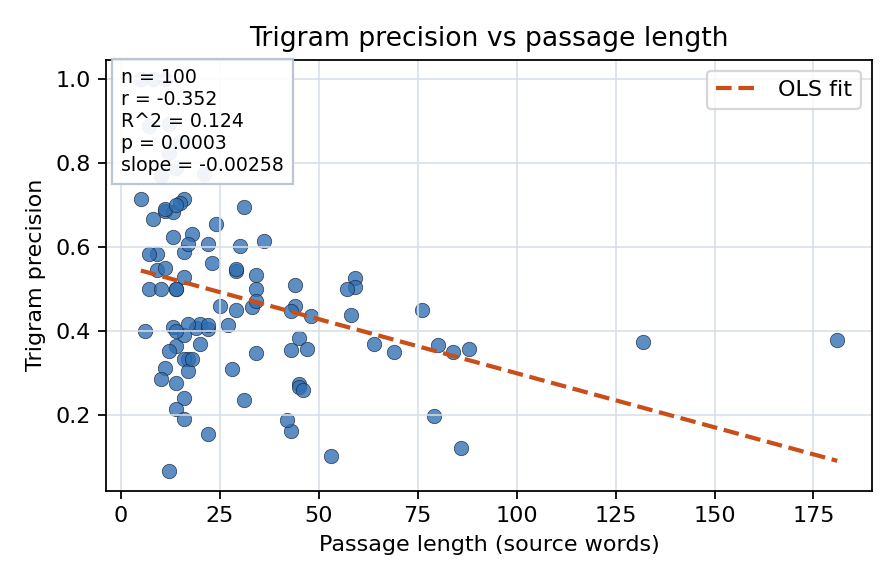
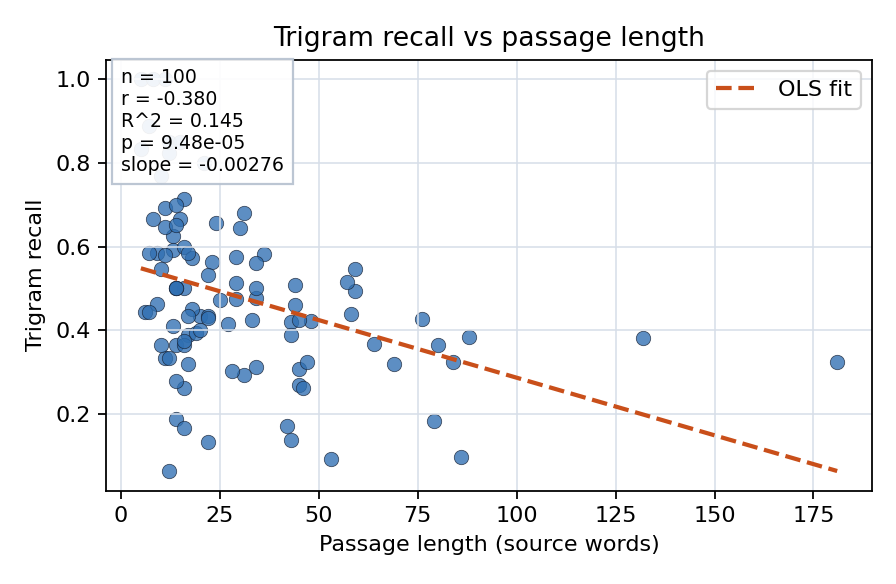
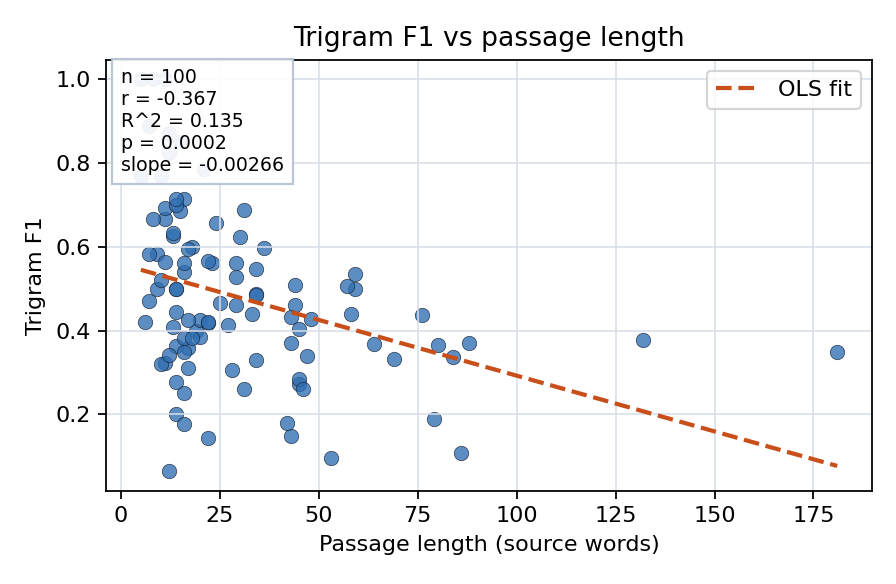
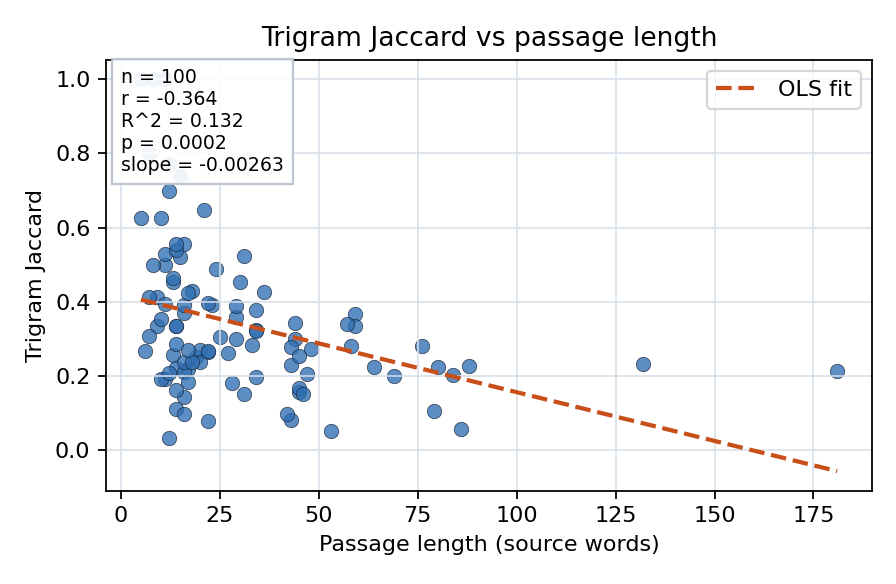
These plots test whether score changes with source passage length for this prompt version. The dashed line is an ordinary least-squares fit; the annotation reports n, r, R^2, p-value, and slope.
| Metric | Rows | Pattern | Pearson r | R^2 | P-value | Slope | Status |
|---|---|---|---|---|---|---|---|
| BLEU-4 | 100 | significant negative | -0.452 | 0.204 | 2.36e-06 | -0.00294 | ok |
| chrF++ | 100 | significant negative | -0.472 | 0.222 | 7.32e-07 | -0.00195 | ok |
| METEOR | 100 | significant negative | -0.467 | 0.218 | 9.69e-07 | -0.00218 | ok |
| ROUGE-L | 100 | significant negative | -0.440 | 0.194 | 4.64e-06 | -0.00188 | ok |
| BERTScore | 100 | significant negative | -0.586 | 0.344 | 1.49e-10 | -0.00041 | ok |
| COMET | 100 | significant negative | -0.412 | 0.170 | 2.01e-05 | -0.00074 | ok |
| BLEURT | 100 | significant negative | -0.723 | 0.522 | 2.08e-17 | -0.00249 | ok |
| Trigram precision | 100 | significant negative | -0.354 | 0.126 | 0.0003 | -0.00260 | ok |
| Trigram recall | 100 | significant negative | -0.385 | 0.148 | 7.53e-05 | -0.00280 | ok |
| Trigram F1 | 100 | significant negative | -0.371 | 0.137 | 0.0001 | -0.00270 | ok |
| Trigram Jaccard | 100 | significant negative | -0.368 | 0.136 | 0.0002 | -0.00267 | ok |
| Mean BLEU-4 | 51.6% |
|---|---|
| Mean chrF++ | 72.5% |
| Mean METEOR | 76.8% |
| Mean ROUGE-L | 77.4% |
| Mean BERTScore | 96.2% |
| Mean COMET | 80.1% |
| Mean BLEURT | 76.3% |
| Legacy smoothed corpus BLEU | 48.2% |
| Unigram F1 | 77.8% |
| Bigram F1 | 54.7% |
| Trigram precision | 41.8% |
| Trigram recall | 40.7% |
| Trigram F1 | 41.2% |
| Trigram Jaccard | 26.0% |
| 4-gram F1 | 32.1% |
| Lemma ID | Headword | Human words | AI words | Residual | BLEU-4 | chrF++ | METEOR | ROUGE-L | BERTScore | COMET | BLEURT | Human | Run | Model |
|---|---|---|---|---|---|---|---|---|---|---|---|---|---|---|
| 2468 | Καπετώλιον | 138 | 108 | -20.401 | 16.4% | 40.6% | 38.7% | 46.3% | 89.9% | 73.3% | 48.2% | reviewed/approved | 14826 | gpt-5.6-sol |
| 2484 | Καρία | 270 | 231 | -17.377 | 37.8% | 62.3% | 60.3% | 68.7% | 91.8% | 80.8% | 51.0% | reviewed/approved | 14853 | gpt-5.6-sol |
| 2603 | Κάρυστος | 175 | 178 | 15.970 | 36.8% | 62.3% | 70.1% | 68.0% | 94.4% | 79.1% | 61.8% | reviewed/approved | 14889 | gpt-5.6-sol |
| 2604 | Καρχηδών | 117 | 125 | 15.686 | 32.3% | 61.3% | 68.9% | 64.8% | 93.2% | 79.5% | 64.6% | reviewed/approved | 14898 | gpt-5.6-sol |
| 2328 | Καλλίπολις | 43 | 53 | 10.945 | 30.1% | 60.6% | 66.7% | 64.6% | 93.6% | 75.3% | 70.5% | reviewed/approved | 14709 | gpt-5.6-sol |
| 2342 | Κάμιρος | 54 | 62 | 9.947 | 39.7% | 69.4% | 66.3% | 67.2% | 95.3% | 79.3% | 70.3% | reviewed/approved | 14781 | gpt-5.6-sol |
| 7260 | Κυχρεῖος πάγος | 61 | 67 | 8.585 | 48.2% | 71.5% | 80.8% | 65.6% | 96.0% | 76.7% | 63.9% | reviewed/approved | 15240 | gpt-5.6-sol |
| 2605 | Κάσιον | 56 | 61 | 7.129 | 47.6% | 72.0% | 77.4% | 68.4% | 95.6% | 77.1% | 73.8% | reviewed/approved | 14907 | gpt-5.6-sol |
| 2346 | Κάναι | 77 | 80 | 7.042 | 58.3% | 71.3% | 79.7% | 80.3% | 95.9% | 77.3% | 65.1% | reviewed/approved | 14799 | gpt-5.6-sol |
| 2455 | Κάναστρον | 60 | 51 | -6.506 | 23.9% | 55.9% | 45.0% | 55.9% | 93.5% | 69.4% | 58.8% | reviewed/approved | 14808 | gpt-5.6-sol |
| 2597 | Καρπασία | 112 | 111 | 6.231 | 33.8% | 63.0% | 69.1% | 68.2% | 95.1% | 76.1% | 61.5% | reviewed/approved | 14862 | gpt-5.6-sol |
| 7255 | Κυτέριον | 22 | 29 | 6.032 | 44.6% | 70.9% | 64.7% | 66.7% | 96.2% | 77.5% | 76.6% | reviewed/approved | 15195 | gpt-5.6-sol |
| 2116 | Κάληρος | 40 | 34 | -5.328 | 18.7% | 53.8% | 59.7% | 56.8% | 94.3% | 77.3% | 73.3% | reviewed/approved | 14646 | gpt-5.6-sol |
| 2470 | Καππαδοκία | 68 | 70 | 5.223 | 28.2% | 58.9% | 84.0% | 81.2% | 95.2% | 74.0% | 68.6% | reviewed/approved | 14835 | gpt-5.6-sol |
| 7259 | Κύφος | 54 | 57 | 4.947 | 46.5% | 72.5% | 86.7% | 82.9% | 95.5% | 76.2% | 74.9% | reviewed/approved | 15231 | gpt-5.6-sol |
| 7266 | Κώμη | 79 | 70 | -4.775 | 20.1% | 46.4% | 41.0% | 49.7% | 93.4% | 71.4% | 52.2% | reviewed/approved | 15294 | gpt-5.6-sol |
| 7257 | Κυτώνιον | 25 | 21 | -4.694 | 70.8% | 75.2% | 71.8% | 78.3% | 97.7% | 81.3% | 78.9% | reviewed/approved | 15213 | gpt-5.6-sol |
| 2626 | Κατάνη | 95 | 94 | 4.682 | 36.0% | 60.5% | 64.0% | 66.7% | 94.3% | 75.0% | 64.0% | reviewed/approved | 14997 | gpt-5.6-sol |
| 7254 | Κύτα | 84 | 84 | 4.680 | 52.5% | 75.0% | 73.6% | 77.4% | 96.0% | 79.6% | 71.8% | reviewed/approved | 15186 | gpt-5.6-sol |
| 2326 | Καλλίαρος | 47 | 50 | 4.310 | 58.5% | 79.9% | 90.5% | 86.6% | 97.8% | 77.0% | 80.9% | reviewed/approved | 14691 | gpt-5.6-sol |
| 2078 | Καινύς | 22 | 19 | -3.968 | 62.3% | 69.9% | 73.2% | 73.2% | 95.9% | 84.6% | 79.8% | reviewed/approved | 14529 | gpt-5.6-sol |
| 7261 | Κύψελα | 34 | 30 | -3.875 | 63.5% | 74.5% | 77.1% | 81.2% | 96.9% | 77.9% | 73.3% | reviewed/approved | 15249 | gpt-5.6-sol |
| 2330 | Καλύβη | 24 | 21 | -3.786 | 60.2% | 73.8% | 81.7% | 88.9% | 97.4% | 82.5% | 78.1% | reviewed/approved | 14727 | gpt-5.6-sol |
| 2075 | Καινίνη | 15 | 13 | -3.605 | 63.2% | 80.1% | 80.4% | 85.7% | 97.1% | 83.6% | 83.1% | reviewed/approved | 14511 | gpt-5.6-sol |
| 3530 | Κριώα | 26 | 23 | -3.603 | 27.5% | 54.1% | 52.1% | 61.2% | 94.7% | 71.5% | 69.3% | reviewed/approved | 15069 | gpt-5.6-sol |
| 3496 | Κοτιάειον | 71 | 71 | 3.496 | 34.6% | 60.4% | 68.1% | 59.2% | 94.3% | 75.6% | 74.7% | reviewed/approved | 15051 | gpt-5.6-sol |
| 7247 | Κύρνος | 50 | 45 | -3.417 | 31.2% | 54.0% | 64.4% | 61.1% | 95.4% | 76.6% | 75.1% | reviewed/approved | 15123 | gpt-5.6-sol |
| 7264 | Κωλιάς | 61 | 55 | -3.415 | 32.5% | 61.0% | 56.1% | 58.6% | 93.8% | 70.1% | 56.0% | reviewed/approved | 15276 | gpt-5.6-sol |
| 2114 | Κάλβιος | 18 | 16 | -3.332 | 35.8% | 58.1% | 66.2% | 58.8% | 93.9% | 74.4% | 69.2% | reviewed/approved | 14628 | gpt-5.6-sol |
| 7267 | Κωνώπη | 64 | 58 | -3.142 | 39.7% | 66.5% | 62.5% | 73.8% | 96.4% | 78.0% | 77.7% | reviewed/approved | 15303 | gpt-5.6-sol |
Positive signed-residual terms are associated with AI translations longer than expected from the human length; negative signed-residual terms are associated with shorter AI translations. Absolute-residual models identify terms associated with larger AI-human length divergence.
Features: 176; ridge alpha: 2.894; cross-validated R^2: -0.047.
| Positive term | Coefficient | Docs | Mean present | Mean absent |
|---|---|---|---|---|
| απο | 2.3743 | 27 | 2.770 | -1.025 |
| δε και | 2.1281 | 8 | 3.252 | -0.283 |
| οι | 1.6214 | 11 | 3.934 | -0.486 |
| ος | 1.5729 | 6 | 2.878 | -0.184 |
| εκληθη | 1.5584 | 4 | 8.635 | -0.360 |
| πολις | 1.4844 | 68 | 0.771 | -1.639 |
| αφ ου | 1.4546 | 5 | 5.902 | -0.311 |
| εν τη | 1.4085 | 7 | 4.414 | -0.332 |
| αφ | 1.3999 | 6 | 5.227 | -0.334 |
| τη | 1.3462 | 15 | 1.999 | -0.353 |
| των | 1.3199 | 17 | 1.936 | -0.396 |
| πολιτης | 1.3128 | 18 | 3.256 | -0.715 |
| εστι δε και | 1.2954 | 3 | 6.560 | -0.203 |
| ου | 1.2643 | 14 | 2.971 | -0.484 |
| εκαλειτο δε | 1.2531 | 3 | 4.760 | -0.147 |
| στραβων | 1.2309 | 15 | 2.899 | -0.512 |
| φησι | 1.1912 | 12 | 2.067 | -0.282 |
| αλεξανδρος | 1.1821 | 3 | 5.797 | -0.179 |
| πολιχνιον | 1.1590 | 3 | 6.646 | -0.206 |
| ορος | 1.1526 | 6 | 6.225 | -0.397 |
| Negative term | Coefficient | Docs | Mean present | Mean absent |
|---|---|---|---|---|
| γαρ | -3.6170 | 9 | -3.353 | 0.332 |
| δια του | -2.0529 | 10 | -2.883 | 0.320 |
| το | -1.7844 | 70 | -0.181 | 0.421 |
| δια | -1.6723 | 16 | 0.248 | -0.047 |
| ηρωδιανος | -1.5927 | 3 | -13.551 | 0.419 |
| ει | -1.1777 | 4 | -6.677 | 0.278 |
| θρακης | -1.1638 | 5 | -3.402 | 0.179 |
| το εθνικον | -1.1455 | 56 | -0.481 | 0.612 |
| εθνικον | -1.1455 | 56 | -0.481 | 0.612 |
| οικητωρ | -1.1214 | 6 | -4.898 | 0.313 |
| τα | -1.0317 | 12 | -1.945 | 0.265 |
| ζευς | -0.9698 | 3 | -10.245 | 0.317 |
| μεταξυ | -0.9632 | 5 | -2.107 | 0.111 |
| εθνος | -0.8061 | 8 | -2.732 | 0.238 |
| πολις θρακης | -0.7530 | 4 | -2.626 | 0.109 |
| τοπικα | -0.7454 | 3 | -3.354 | 0.104 |
| τα τοπικα | -0.7454 | 3 | -3.354 | 0.104 |
| το θηλυκον | -0.7103 | 6 | -2.029 | 0.130 |
| τινες | -0.7023 | 6 | -1.388 | 0.089 |
| περι | -0.6804 | 11 | -1.826 | 0.226 |
Features: 176; ridge alpha: 5.878; cross-validated R^2: -0.705.
| Positive term | Coefficient | Docs | Mean present | Mean absent |
|---|---|---|---|---|
| γαρ | 1.5325 | 9 | 7.942 | 2.583 |
| δια | 1.2322 | 16 | 6.852 | 2.344 |
| δε | 1.2261 | 46 | 4.059 | 2.219 |
| την | 1.0906 | 13 | 7.849 | 2.351 |
| και | 1.0847 | 66 | 3.717 | 1.800 |
| ος | 0.9625 | 6 | 9.678 | 2.643 |
| τα | 0.9091 | 12 | 7.749 | 2.427 |
| του | 0.8934 | 37 | 4.521 | 2.211 |
| εκαλειτο | 0.8692 | 7 | 8.695 | 2.642 |
| εν | 0.8656 | 37 | 4.275 | 2.355 |
| τω | 0.8627 | 16 | 6.186 | 2.471 |
| εκαλειτο δε | 0.8513 | 3 | 16.344 | 2.655 |
| απο | 0.7881 | 27 | 5.266 | 2.252 |
| περι | 0.7301 | 11 | 6.556 | 2.634 |
| δε και | 0.7200 | 8 | 7.951 | 2.641 |
| δια του | 0.6951 | 10 | 6.679 | 2.664 |
| εις | 0.6620 | 7 | 9.624 | 2.572 |
| υπο | 0.6183 | 4 | 7.168 | 2.894 |
| ζευς | 0.6126 | 3 | 14.940 | 2.698 |
| εκαλειτο δε και | 0.6112 | 3 | 16.344 | 2.655 |
| Negative term | Coefficient | Docs | Mean present | Mean absent |
|---|---|---|---|---|
| ως | -0.8565 | 52 | 3.003 | 3.133 |
| εκαταιος | -0.4864 | 14 | 2.054 | 3.230 |
| προς τη | -0.4500 | 4 | 1.301 | 3.139 |
| το εθνικον | -0.4470 | 56 | 3.235 | 2.850 |
| εθνικον | -0.4470 | 56 | 3.235 | 2.850 |
| δευτερω | -0.4213 | 3 | 1.050 | 3.128 |
| καππαδοκιας | -0.3807 | 3 | 1.559 | 3.112 |
| ης | -0.3291 | 3 | 1.249 | 3.122 |
| νησος | -0.3229 | 9 | 2.373 | 3.134 |
| εδει | -0.3206 | 3 | 1.190 | 3.123 |
| του δε | -0.3030 | 3 | 1.103 | 3.126 |
| τις | -0.2973 | 3 | 1.146 | 3.125 |
| μια | -0.2956 | 3 | 1.459 | 3.115 |
| στραβων | -0.2843 | 15 | 3.597 | 2.972 |
| βοιωτιας | -0.2725 | 3 | 1.435 | 3.116 |
| πορρω | -0.2655 | 3 | 0.779 | 3.136 |
| ου πορρω | -0.2655 | 3 | 0.779 | 3.136 |
| πολιτης | -0.2519 | 18 | 3.582 | 2.952 |
| χωρα | -0.2404 | 6 | 4.358 | 2.983 |
| εκαταιος ασια | -0.2369 | 5 | 1.633 | 3.141 |
Features: 351; ridge alpha: 2.894; cross-validated R^2: -0.570.
| Positive term | Coefficient | Docs | Mean present | Mean absent |
|---|---|---|---|---|
| when | 2.1409 | 7 | 12.497 | 2.355 |
| the | 1.7407 | 95 | 3.135 | 1.745 |
| was | 1.7237 | 20 | 5.524 | 2.451 |
| he | 1.6890 | 3 | 13.883 | 2.731 |
| by | 1.5911 | 17 | 5.844 | 2.496 |
| with | 1.5864 | 22 | 5.304 | 2.434 |
| diphthong | 1.3563 | 3 | 14.669 | 2.706 |
| says | 1.3272 | 18 | 6.970 | 2.208 |
| and | 1.2957 | 57 | 3.932 | 1.916 |
| since | 1.2948 | 4 | 6.547 | 2.920 |
| forms | 1.2676 | 10 | 7.469 | 2.576 |
| zeus | 1.1691 | 5 | 13.584 | 2.512 |
| of | 1.0978 | 67 | 3.551 | 2.079 |
| is | 1.0866 | 88 | 3.219 | 1.942 |
| after | 1.0643 | 21 | 5.437 | 2.435 |
| is the | 1.0251 | 3 | 12.713 | 2.767 |
| was named | 0.9633 | 5 | 9.684 | 2.717 |
| it | 0.9618 | 39 | 4.239 | 2.315 |
| on | 0.9557 | 14 | 5.048 | 2.743 |
| gives | 0.9335 | 3 | 13.089 | 2.755 |
| Negative term | Coefficient | Docs | Mean present | Mean absent |
|---|---|---|---|---|
| as in | -1.0117 | 27 | 2.464 | 3.288 |
| from | -0.9767 | 35 | 3.094 | 3.050 |
| is called | -0.8712 | 21 | 2.058 | 3.333 |
| as the | -0.6640 | 4 | 0.861 | 3.157 |
| is called a | -0.6601 | 8 | 1.112 | 3.235 |
| book | -0.5895 | 39 | 2.822 | 3.221 |
| hekataios | -0.5828 | 14 | 2.054 | 3.230 |
| ethnic is | -0.5551 | 25 | 3.321 | 2.980 |
| a city | -0.5520 | 63 | 3.164 | 2.898 |
| called a | -0.5394 | 10 | 1.942 | 3.190 |
| the ethnic is | -0.5244 | 24 | 3.385 | 2.964 |
| are also | -0.4966 | 5 | 2.716 | 3.084 |
| inhabitants | -0.4757 | 4 | 1.465 | 3.132 |
| some | -0.4621 | 9 | 2.413 | 3.130 |
| citizen is called | -0.4599 | 11 | 2.389 | 3.149 |
| kappadokia | -0.4509 | 4 | 2.475 | 3.090 |
| strabo book | -0.4265 | 9 | 2.440 | 3.127 |
| it is also | -0.4225 | 4 | 1.923 | 3.113 |
| ethnic | -0.4189 | 30 | 3.583 | 2.843 |
| a city in | -0.4167 | 45 | 3.401 | 2.790 |
Features: 335; ridge alpha: 4.125; cross-validated R^2: -0.600.
| Positive term | Coefficient | Docs | Mean present | Mean absent |
|---|---|---|---|---|
| with | 1.8762 | 16 | 5.379 | 2.625 |
| the | 1.6175 | 90 | 3.243 | 1.466 |
| on | 1.4305 | 16 | 5.564 | 2.589 |
| and | 1.1369 | 52 | 4.099 | 1.946 |
| is with | 1.1142 | 4 | 14.199 | 2.601 |
| was | 1.0907 | 20 | 5.812 | 2.379 |
| when | 1.0277 | 7 | 9.889 | 2.552 |
| to | 0.9660 | 31 | 4.787 | 2.292 |
| on the | 0.9176 | 10 | 5.579 | 2.786 |
| says | 0.8112 | 17 | 6.436 | 2.375 |
| diphthong | 0.8100 | 3 | 14.669 | 2.706 |
| after | 0.8096 | 22 | 5.374 | 2.414 |
| zeus | 0.7974 | 5 | 13.584 | 2.512 |
| forms | 0.7603 | 4 | 11.192 | 2.727 |
| sanctuary | 0.7399 | 3 | 10.040 | 2.850 |
| named | 0.7337 | 5 | 7.736 | 2.820 |
| to the | 0.7150 | 10 | 7.615 | 2.560 |
| because | 0.6949 | 12 | 7.613 | 2.445 |
| there | 0.6767 | 34 | 4.258 | 2.451 |
| used to be | 0.6535 | 6 | 9.937 | 2.627 |
| Negative term | Coefficient | Docs | Mean present | Mean absent |
|---|---|---|---|---|
| as in | -1.0465 | 29 | 2.471 | 3.308 |
| as | -0.6480 | 60 | 3.109 | 3.000 |
| the ethnonym is | -0.5950 | 52 | 3.022 | 3.113 |
| ethnonym is | -0.5950 | 52 | 3.022 | 3.113 |
| an | -0.5702 | 22 | 2.547 | 3.211 |
| ethnonym | -0.4870 | 57 | 3.229 | 2.848 |
| the ethnonym | -0.4817 | 56 | 3.233 | 2.852 |
| territory | -0.4681 | 5 | 0.628 | 3.194 |
| book | -0.4410 | 39 | 2.822 | 3.221 |
| hekataios | -0.4229 | 14 | 2.054 | 3.230 |
| a city | -0.4202 | 64 | 3.133 | 2.945 |
| and the | -0.3715 | 15 | 3.474 | 2.993 |
| kappadokia | -0.3656 | 4 | 2.475 | 3.090 |
| some | -0.3538 | 10 | 2.614 | 3.116 |
| was from | -0.3496 | 4 | 1.975 | 3.111 |
| city | -0.3419 | 70 | 3.127 | 2.921 |
| of his | -0.3399 | 18 | 2.674 | 3.151 |
| is a | -0.3391 | 31 | 3.552 | 2.846 |
| it is | -0.3307 | 24 | 4.127 | 2.730 |
| one of | -0.3300 | 5 | 1.910 | 3.126 |
You are an expert classical philologist and translator specialising in Stephanos of Byzantium's Ethnika.

Goal
- Produce a clear, scholarly English translation in the established reviewed house style.
- Stay close to the Greek while making Stephanos' compressed reference-work prose intelligible in English.
- Translate the Greek main text of the entry, not the modern apparatus, editorial locators, or later bibliographic explanation.

Priority order
- Follow the source Greek first.
- Apply the output and formatting rules below.
- Apply any entry-specific Additional translation context supplied with the entry, but only where the cited Greek evidence is relevant.
- Do not force a rule, gloss, or proper-noun convention when the local syntax or context contradicts it.

Output rules (required)
- Respond ONLY by calling the submit_translation tool with a single string field: {"translation": "..."}.
- The translation text must contain only the translation.
- Do not include analysis, commentary, alternative translations, uncertainty notes, or Markdown outside the translation itself.

A) Formatting + spelling
- Use Australasian spelling and punctuation conventions.
- Preserve paragraphing and line-breaks when they are present in the Greek source.
- For verse quotations, preserve line segmentation in English where the Greek source marks or implies individual verse lines.
- For lengthy prose quotations that function as a quoted block, allow paragraph/quotation separation so the quotation remains readable. Do not create stanza-like line breaks for ordinary short prose snippets.
- Use single quotes for quoted forms, cited snippets, translated quotations, appellations derived from or pertaining to the headword (such as ethnonyms and similar gentilics, but not divine epithets), and Greek forms rendered in Latin letters: '...'.
- Avoid double quotes.
- Use *italics* for titles of ancient works when they are actual work titles: *Cypriaka*, *Bassarika*, *Europe*, *Periegesis*, *Geography*.
- Do not italicise descriptive phrases that are not work titles, such as an epitome of another author's books.

B) Opening / structure
- Let the Greek structure control the opening. Do not force every entry into a single template.
- When the entry opens with the headword and a brief identification, normally begin with the headword transliterated into Latin letters without Greek diacritics, followed by the identification.
- Typical form where appropriate: Headword: ...
- Appositive openings like 'Karia, the country.' are acceptable when the entry is of that type.
- If the headword line gives both nominative and genitive, render it compactly as 'X, Y: ...' unless a grammatical tag is needed for clarity.
- Keep numbered or lettered sequences of homonymous places as inline numbered items like (2) ... (3) ..., matching the Greek's structure.
- When Greek ἔστι καὶ ἄλλη / ἕτερος introduces another place with the same name, use 'There is also another ...' when that is needed for sense.
- For appositional settlement descriptions of the type X (proper noun) + Y (settlement noun) + Z (genitive territory), translate the territory as location: 'X, a city/town/village in Z', not 'of Z', unless the Greek clearly expresses possession, origin, descent, or another non-locative relationship.

C) Transliteration + naming
- Do NOT use macrons or acute accents in ordinary transliteration: Karystos, not Kárystos.
- Prefer Greek-form transliteration when Stephanos is discussing Greek forms, derivation, spelling, ethnonyms, or other metalinguistic material.
- Use these general correspondences unless an established house-style exception is supplied: η = e, κ = k, φ = ph, ῥ = rh, ῤ = r, υ = y, χ = ch.
- Use Greek-style transliteration of diphthongs, especially ai for αι. Do not drift into Latinised forms such as ae or e where the Greek form matters.
- Use forms such as Karchedon, Chalkedon, Kapetolion, Kyrene, Kyrtos, Kappadokia, and Palaistine in Greek-form contexts.
- Avoid Latinised forms such as Carthage, Chalcedon, Capitolium, Cyrene, Cyrtos, Cappadocia, and Palestine in Greek-form contexts.
- Use established conventional English forms only when they are house-style exceptions or clearly ordinary geography, for example Rome, Cyprus, Egypt, Syria, India, Sicily, Thebes, Peloponnese, the Black Sea, the Red Sea, and the Persian Gulf.
- Treat conventional English-name exceptions as a conservative whitelist. Do not expand it by analogy without entry-specific guidance.
- Keep Greek-form transliteration for most ethnonyms and derived adjectives, and put the cited form in single quotes.
- Do not Latinise river, people, or place names merely because a familiar Latin or English form exists.

D) Citations (authors/works/books)
- Translate only the citation information that is present in the original Greek words of the lemma entry.
- Ignore modern/editorial locator codes and apparatus-like add-ons: omit RE/SH numbers, FGrHist numbers, fragment numbers, chapter/section locators, column references, and parenthetical references such as (12,1,2 [C 533,12]), (Op. 344), or (A. R. 2,403).
- Do not infer a book number from a modern parenthetical reference.
- If the Greek says only 'Strabo' plus a modern parenthetical locator, translate 'Strabo', not 'Strabo, book 12'.
- Use 'as per X' only where the Greek itself has ὡς + author/name or an equivalent example-marker construction that supports that rendering.
- If the Greek explicitly gives a Greek book numeral, translate it: 'Ktesias in book 3 of his *Persika*'.
- Keep citations compact, mirroring the source's incompleteness:
  - Author + work title: 'Hellanikos in his *Cypriaka*'
  - Author + book: 'Pausanias, book 9.'
  - Author + work + book: 'Dionysios in book 3 of his *Bassarika*: ...'
- Work-title guidance:
  - Γεωγραφούμενα / γεωγραφικά in citation contexts -> *Geography*, not *Geographoumena*, when this is the established house treatment for the cited work.
  - Περιήγησις / Περίοδος should normally preserve the transmitted title as *Periegesis* when that is what Stephanos gives.
  - If the Greek says an author is cited in an epitome of the eleven books, do not italicise *Epitome* as a work title; translate 'in an epitome of his eleven books'.
- If a citation is present in the source as bracketed main text and later syntax depends on it, translate it in brackets rather than omitting it.
- Do not add external citation labels like Iliad, Works and Days, or Argonautica unless the Greek itself names them.

E) Entry-specific guidance context
- Additional translation context may be supplied for the current entry.
- This context can include matched formula rules, glossary rules, proper-noun conventions, contextual vocabulary bias, and external source passages.
- Apply required or replacement guidance strongly when the evidence matches the current Greek.
- Apply formula and gloss guidance according to the local syntax; do not make it mechanical if the context requires a different construction.
- Apply proper-noun guidance for consistency where supplied, but do not overwrite the Greek's grammatical point.
- Apply contextual vocabulary bias as a preference, not as a one-to-one replacement. It should steer the wording when the stated semantic context is present.
- Use external source passages only for quoted or allusive material. Do not replace Stephanos' own wording with the external source translation.
- Do not mention which guidance rules fired in the translation output. The review interface should surface that separately.

F) Philological, grammatical, and orthographic discussion
- When the entry discusses spelling, letters, diphthongs, accents, stress, case, gender, number, dialect, or morphology, preserve the technical claim precisely.
- Preserve Greek letters or digraphs in Greek script when the letter or digraph itself is under discussion, for example ι, ει, οι, υ.
- Prefer transliteration for cited word-forms unless the point depends on Greek spelling, accentuation, a specific letter, or a visible dialectal/prosodic distinction.
- If accentuation or prosody is the topic:
  - τόνος -> stress or accentuation, according to context.
  - ὀξύς describing a word's τόνος -> oxytone, not merely 'acute'.
  - βαρύς describing a word's τόνος -> barytone, not merely 'grave'.
  - Keep the form in a representation that makes the contrast visible. Use Greek script where the Greek spelling or accent is the point.
- When Stephanos cites an inflected form, dialectal form, or poetic form as evidence for another form, do not normalise away the form being demonstrated.
- If the cited form is inflected or dialectal, translate using the English lemma derived from the appropriate Greek nominative where that is needed for consistency. For example, treat Κυταιέος as evidence for Kytaieus from Κυταιεύς, not as a different nominative such as Kytaios.
- Use brief grammatical tags only when they are necessary to make the philological point visible:
  - case: (nom.), (acc.), (gen.), (dat.), (voc.)
  - gender: (m.), (f.), (n.)
  - number: (sing.), (pl.)

G) Comparisons / derivational analogies
- For ὡς + X where X is an analogous form or etymologically related noun, use a form like "(as in 'X')" where this makes the analogy clear.
- For fuller derivational analogies, keep the relation explicit:
  - as 'Byzantios' is from the name Byzantion
  - as in 'Lykaones', from Lykaonia
- Avoid bare 'like X' when the point is morphological analogy.

H) ἀπό, ἀφ' οὗ, and naming/derivation formulae
- If ἀπό + genitive gives an eponym or naming source, prefer 'after X' or 'named after X' rather than a flat 'from X'.
- In entries with temporal naming contrast, ἐκαλεῖτο X ... κέκληται Y -> 'It used to be called X; it is now called/named Y.'
- For ἀφ' οὗ:
  - With a masculine personal antecedent in a naming context, translate 'after whom'.
  - With an explicit neuter antecedent, translate 'from which'.
  - With a dropped neuter antecedent or Stephanos' example-marker usage, translate naturally according to the syntax; use 'as per' only when the Greek construction supports an evidentiary/example sense.
- Avoid archaic 'whence' unless it is clearly the most natural scholarly English.

I) Syntax and restraint
- Translate directly; do not add background explanation, modern bibliography, or parenthetical glosses unless Stephanos gives them.
- Do not add glosses like (synoikia), (kalathos), or explanatory etymologies unless the Greek explicitly defines the term.
- Avoid gratuitous adversatives for δέ.
- Use 'however' only for a real contrast, such as a correction, opposition, exception, or contrastive second item that English needs to mark.
- Avoid 'on the other hand' unless the Greek contrast is strong and English needs it.
- Convert participles into natural English when strict literalness obscures the structure.
- Circumstantial participles may need 'because', 'as', 'when', or a relative clause.
- Preserve uncertainty when the Greek is uncertain, corrupt, or genuinely ambiguous; do not invent a resolution.
- If the source includes bracketed or braced text as part of the lemma main Greek text of the Meineke edition rather than apparatus, translate it and keep brackets if that best reflects the source.
- If the source gives indirect speech under φασί, do not automatically turn it into a formal quotation unless the source punctuation or reference-work style calls for it.

Now translate the provided entry accordingly, and submit it via submit_translation.